InfCoiL: Coordinated Planner-Controller Learning for Closed-Loop Physics-Based Human-Object Interaction
 InfCoiL:
1Shanghai Jiao Tong University 2Shanghai Artificial Intelligence Laboratory
Abstract
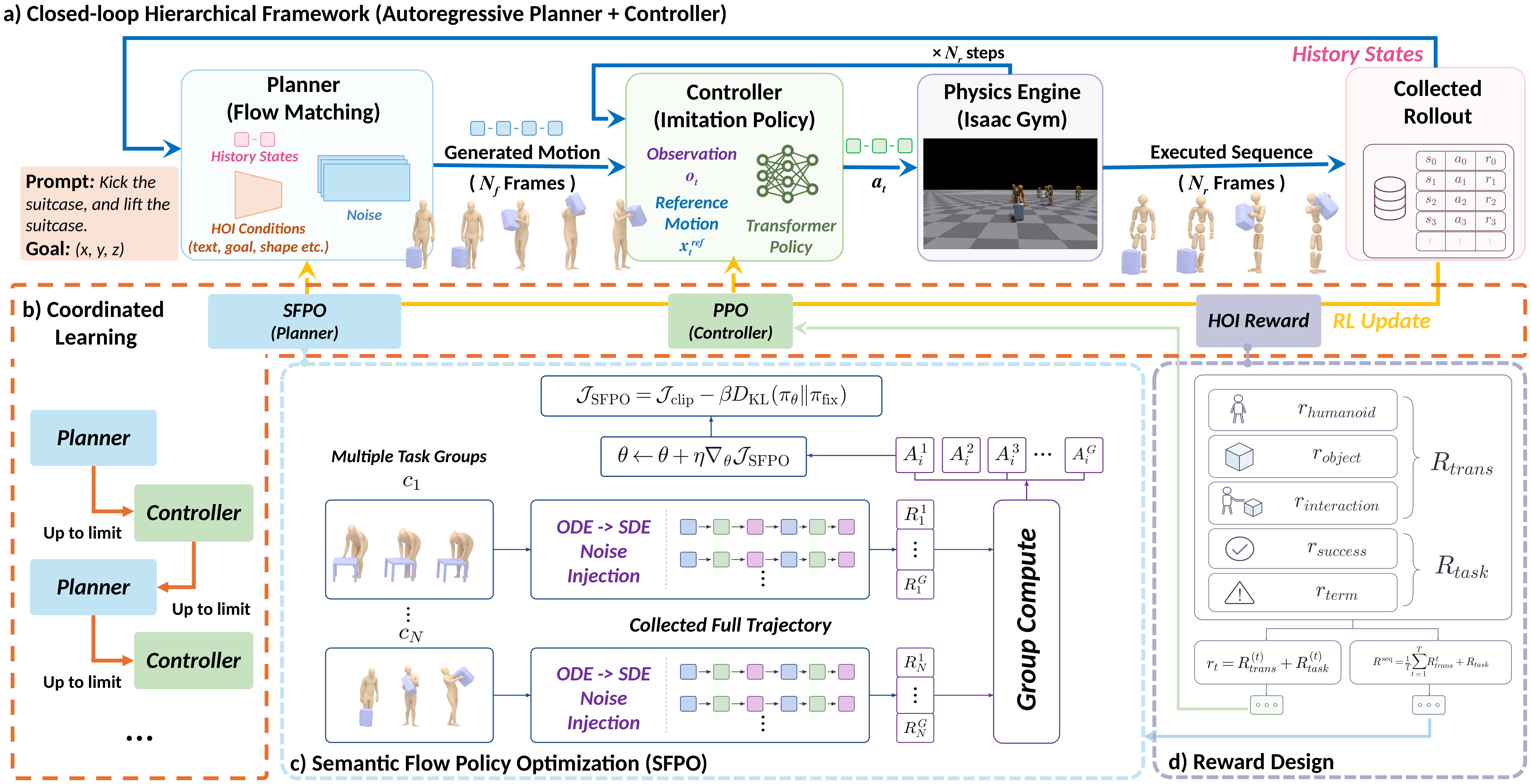
Text- and goal-conditioned human-object interaction (HOI) provides an intuitive interface for specifying high-level intents in physics-based character animation. Mapping such intents to physically plausible, contact-rich behaviors naturally calls for a generative planner and a physics-based controller, yet existing planner-controller systems either execute plans open-loop or close the loop while keeping the planner fixed, so execution feedback never reshapes what is planned. We present InfCoiL, a closed-loop framework for physics-based HOI from coordinated planner-controller learning. InfCoiL couples a morphology-aware flow-matching planner with a unified multi-morphology controller through a shared morphology interface in an autoregressive plan-and-execute loop, and alternately fine-tunes both components with reinforcement learning from the same physical rollouts. To optimize the flow-matching planner online, we introduce Semantic Flow Policy Optimization (SFPO), which stochasticizes selected denoising transitions with channel-wise semantic covariance over heterogeneous HOI features and assigns group-relative, sequence-level rewards from complete closed-loop executions. On held-out OMOMO sequences, InfCoiL outperforms open-loop hierarchical baselines in goal-reaching task success and physical tracking accuracy.
Methodology
Results and Analysis
We compare InfCoiL with two open-loop baselines and four internal variants.
Table 1. Task-oriented evaluation on the re-split OMOMO test set. Each sequence is evaluated three times and metrics are averaged. C and P denote controller (PPO) and planner (SFPO) fine-tuning phases: InfCoiL (C→P) uses 10k controller iterations followed by 500 planner iterations, and InfCoiL (C→P→C) adds 4k further controller iterations.
| Method | SR@0.3↑ | Eh↓ | Eo↓ | Pelvis Goal↓ | Object Goal↓ |
|---|---|---|---|---|---|
| InterMimic student (open-loop) | 24.62 | 9.23 | 16.89 | 90.39 | 111.89 |
| SimGenHOI* (open-loop + SFT) | 52.14 | 9.69 | 18.00 | 50.12 | 68.15 |
| InfCoiL open-loop | 49.23 | 9.40 | 18.08 | 57.15 | 75.51 |
| InfCoiL w/o FT P & C | 56.09 | 7.25 | 16.10 | 46.89 | 69.83 |
| InfCoiL w/o FT C | 56.98 | 7.75 | 16.36 | 47.02 | 70.60 |
| InfCoiL w/o FT P | 73.37 | 8.44 | 14.67 | 35.72 | 49.45 |
| InfCoiL (C→P) | 77.24 | 8.90 | 14.76 | 32.90 | 45.37 |
| InfCoiL (C→P→C) | 81.19 | 8.87 | 14.21 | 31.31 | 41.51 |
BibTeX
@inproceedings{zou2026infcoil,
  title     = {{InfCoiL}: Coordinated Planner-Controller Learning for Closed-Loop Physics-Based Human-Object Interaction},
  author    = {Zou, Yude and Yao, Yifei and Hao, Yiwei and Wang, Hanqing and Gao, Xing},
  booktitle = {Advances in Neural Information Processing Systems},
  year      = {2026}
}